

This is how the DEAR Smart Care Pathway transforms IBD care.
DEARhealth enables IBD care to be tailored to the individual patient's needs. By combining real-time patient-reported data with EHR data, an up-to-date risk profile is created that dynamically evolves with the clinical situation. The DEAR Recommender, the engine/power of our solution, supports healthcare professionals with transparent, guideline-driven recommendations and predictive insights. DEARhealth aims to support clinical decision-making in order to reduce healthcare utilization, without compromising treatment quality or patient engagement.


DEARhealth understands the challenges in IBD care
As an IBD healthcare professional, you want to deliver best possible care for your patients every day. The low threshold for care requests creates a practical challenge: workload increases while time per patient decreases. At the same time, healthcare faces a broader strategic challenge: the transition to digital, hybrid and transmural care. This transition creates the required pressure and smart, future-proof decisions.
In daily practice, days are often filled with patients who's disease is in contol and attend for routine follow-ups. Meanwhile, a smaller group of patients with more complex disease trajectories requires intensive attention and rapid intervention. Due to the lack of effective prioritization and questions through various digital tools, it becomes increasingly difficult to identify the patients who need your expertise most urgently at that moment.
The DEARhealth Smart Care Pathway is the solution. A system that supports the IBD team, now and in the future.
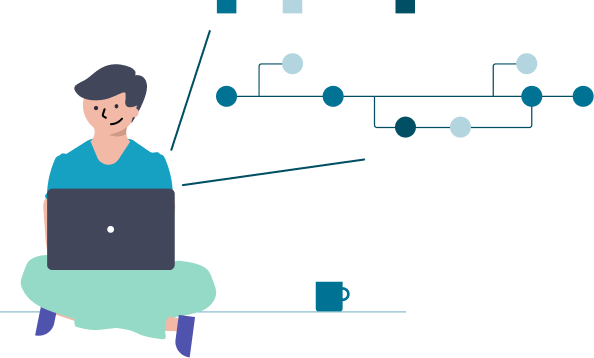
The missing element in effective task shifting
There is a great desire and need to restructure IBD care: the nurse specialist as the director of the stable population, so that the MDL doctor has his hands free for complex issues. With the right technical support, this provides many advantages in practice, including:

Space for the nurse practitioner
The nurse practitioner no longer spends valuable time manually sorting unfiltered data and questions and thus has more time for direct patient care.

No unnecessary conversations
Thanks to predictive insights and clinical validation, the nurse practioner only needs to ask the doctor in case of great doubt. This saves time for the doctor.

Proactive direction
Instead of 'putting out fires' based on reactive signals, the care team has a system that pre-sorts based on urgency and clinical relevance.

Scalable and future-proof
Not a quick fix with partial solutions, such as separate Telemonitoring software, but a solution that forms the basis for solid hybrid care, both in the hospital and transmural.
DEARhealth Smart Care Pathway

Data-driven risk profiling
Real-time monitoring and EHR data dynamically determine the risk profile and matching care pathway.
Smart decision support
Transparent Recommender supports doctors with guideline-based, predictive advice.

Attention
Fewer unnecessary hospital visits at low risk, more attention to complex patients.
More control for patient and healthcare professional
Fewer hospital visits and care that adapts to the patient's personal situation.
More efficient use of capacity
Time, attention and resources where they have the most clinical impact.
DEARhealth Smart Care Pathway that adapts to the patient
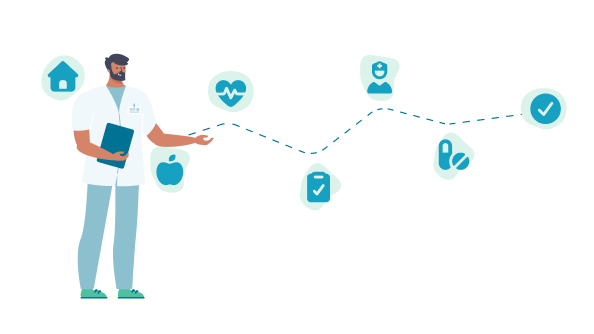
When a patient is doing well, appointments can safely be postponed or handled by phone. This results in more time and attention for complex care. The healthcare professional decides which care pathway best fits the patient’s situation.
Patients feel heard and involved because their situation receives continuous attention and they are no longer dependent on scheduled appointments in the hospital.
When patient responses indicate possible disease activity or concerns, the care team automatically receives a notification and can schedule an appointment if needed.
At the same time, healthcare professionals maintain overview and control over their patient population. Before their appointment, healtcare professionals have insight into completed questionnaires and know exactly how the patient is doing. Only the responses that stand out in the questionnaire will be discussed, this results in focus on what truly matters during their appointment.
““The patient gains more room for self-management. The DEARhealth Recommender determines the patient’s risk level based on data. If the risk is low, less hospital time is required. At high risk, the physician becomes involved. The software continuously adapts to the patient’s situation.””

Dr. R. Jacobs
Gastroenterologist at Alrijne Hospital
Read more about how the IBD team at Alrijne Hospital works with the Smart Care Pathway